
![The Forgotten Pivot – When Keeping What You Earn Became Radical [VIDEO]](https://i2.wp.com/austincountynewsonline.com/wp-content/uploads/2026/01/taxes.png?w=1280&resize=1280,640&ssl=1 "The Forgotten Pivot – When Keeping What You Earn Became Radical [VIDEO]")
Americans have long been taught that taxation is simply the price of civilization: roads, courts, armies, the social contract. Citizens pay their share. That is the deal. That has always been the deal.
Except it has not.
A deeper examination of the primary records shows that this bedrock assumption dissolves, not slowly, but all at once, the way a stone shatters a still reflection. One sentence, buried in the congressional debates of 1911, began the unraveling.
“The American citizen has never in the history of this republic been compelled to surrender a portion of his labor directly to the federal government.”
That statement was not from a fringe pamphlet. It was entered into the official legislative history of the United States. Two years later, everything changed.
On February 3, 1913, the 16th Amendment was ratified, granting Congress the power to lay and collect taxes on incomes “from whatever source derived, without apportionment among the several States.” By October of that same year, the Revenue Act of 1913 created the first permanent federal income tax. In December, President Woodrow Wilson signed the Federal Reserve Act. Two transformative pieces of financial legislation arrived in the same calendar year.
Before 1913, the federal government operated almost entirely on tariffs, import duties, and excise taxes on specific goods; alcohol, tobacco, luxuries. These were taxes on transactions or consumption, not on the product of individual labor. A skilled tradesman in 1890 negotiated his wage and kept it in full. A homesteader improved 160 acres under the Homestead Act and owed the federal government nothing on the fruits of that labor. The distinction is profound: indirect taxes touch a person only when they choose to buy something; a direct income tax touches a person simply for producing.
The Supreme Court had drawn this boundary clearly. In 1895, in Pollock v. Farmers’ Loan & Trust Co., the justices struck down an earlier income tax as an unapportioned direct tax, violating Article I of the Constitution. The Civil War-era income tax had been temporary and was repealed in 1872. For most of the republic’s history, the federal government had held no permanent, peacetime claim on individual earnings.
The 1913 tax began modestly: 1 percent on net income above roughly $3,000–$4,000 (exempting the vast majority of Americans), rising to a top marginal rate of 7 percent on incomes over $500,000. Proponents presented it as a small, reasonable measure. Yet by 1918 the top rate had climbed to 77 percent. By 1944 it reached 94 percent. The precedent, not the initial rate, proved to be the point.
The enforcement apparatus expanded with equal speed. The Bureau of Internal Revenue (predecessor to today’s IRS) already handled excises, but the income tax required an entirely new scale. By the late 1910s, regional offices, special agents, and intelligence units operated across the country. What had been zero infrastructure for taxing personal labor in 1912 became a coordinated national system within a few short years, driven first by wartime revenue demands and then by permanence. IRS historical records document the rapid scaling that followed ratification.
In 1943, the Current Tax Payment Act introduced mandatory withholding from paychecks. Before then, workers received their full gross wage and paid the government later. Withholding changed the psychology: the money never felt like it belonged to the worker in the first place. Net pay became “pay.” The gross became an abstraction on a form. Introduced during wartime, when dissent could be framed as unpatriotic, it made the extraction invisible and routine.
This development was not uniquely American. Similar income-tax systems—with reporting, calculation, and criminal penalties for non-compliance—spread across industrialized nations in a remarkably compressed historical window: Britain made its temporary wartime tax permanent in 1842; Germany in the 1870s–80s; other Western countries in the early 20th century. Industrial wage labor created new taxable streams, but the uniformity of the architecture and enforcement mechanisms across rival nations remains striking.
The deepest shift was philosophical. Pre-1913 America operated on the assumption—embedded in its constitutional design, though never explicitly stated—that what a person produced belonged first to that person. The federal government held no direct, prior claim on labor, craft, or time. That assumption is gone. The new default, now so normalized that the old one sounds radical, is that income belongs first to the state, which then permits the individual to keep a portion.
This change did not occur in a war or revolution. It was surrendered incrementally, sold at first as a modest reform affecting only the wealthy. The criminal category of “failure to file” or “tax evasion” at the personal level did not exist before 1913—because the obligation did not exist. A new form of non-violent criminality was invented: not harming another person, but failing to surrender part of one’s own productive output to a central authority.
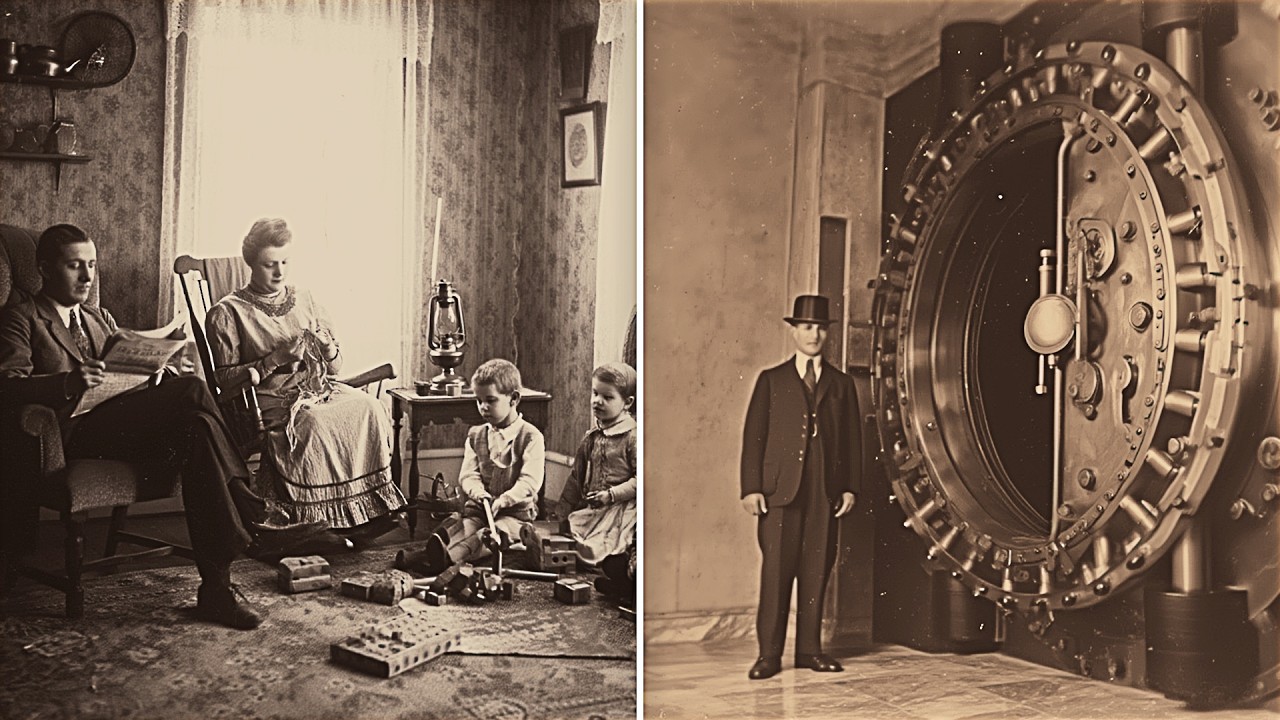
Americans’ great-grandparents lived in a world where keeping what one earned was simply the normal course of life. Photographs of them exist. Letters survive. That world ended, legally and constitutionally, in one year, with one amendment. The question that lingers in the archives, in the margin notes of forgotten congressmen, is not whether the change happened—the documents are clear—but why the architecture was built this way, and what exactly its designers believed they were constructing.
Americans are still living inside that structure. Most have never questioned the walls.
The video embedded below explores these same primary sources and timelines in greater depth. What began as a single footnote in a 1911 debate has become one of the most consequential pivots in American history.
Further reading and primary sources
